300,000 years old: the age of what we consider the oldest human fossils on record. If this scientific guess is taken to be true, then the human species has lived through approximately, if we estimate and average parenthood of 20-25 years, 12,000 – 15,000 generations, each with their own individuals who create their own branching families.
Despite this generational immensity, the ‘modern human’ as we know today: city dwellers or agricultural enjoyers who write and perform transactions did not emerge until about 6000 years ago in 4000 BC. 6000 years ago the city of Uruk was founded, considered the first true city and the birthplace of writing.
These 6000 years led to an explosion of thought and technology, eventually leading to today where I can tap buttons on a electronic thinking machine, that then creates a mountain of glyphs called writing, which I can then publish to a meeting ground where no one leaves their home called the ‘Internet’.
This is strange: 6000 years, that is about 240 – 300 individual generations. By no means small, but feasibly if we took one person from each generation we might fit them all in a small auditorium. That would be a sight, a representative from each persons genetic lineage, all there to attest to the worlds they lived in, connected by those who came before and after them,
That is unless we are to believe speculative history, which attests human civilization rose before the city of Uruk, supported by sites like Gobekli Tepe, a monument built by Hunter Gatherers almost 12,000 years ago.
Or the assertions that perhaps passed calamities wiped out any trace of civilization. But ought we to believe this speculative history? How do we know what to believe – what is story, and what is fact?
I would argue that anything we believe is a story and/or a system of thought; worldbuilding, in short. This worldbuilding is not only responsible for the mental picture we have of today’s world, but also humanities light speed rise in technology and power. Humans are storied creatures, and we rely upon stories and systems to create a mental model of the world to act on. Worldbuilding is not a mere mental excercise or hobby for would-be fantasy novelists, but is the fundamental cognitive skill humans use to organize reality.
What is worldbuilding? Worldbuilding is the systematic creation of stories and systems that a group or individual might operate under or by; ie, the shape of continents on a map is worldbuilding as it delegates the possible transportation, navigation, and construction a group might do.
Further, worldbuilding is also a shared endeavor of belief, money is a great example of this: most countries have their own currency, their own leaders and cool animals emblazoned on different colored paper bills and metal coins.
None of this money would work however unless most of the people in that nation maintained a shared belief in the system. Economics attempts to maintain this belief through a delicate balancing – when this balance is lost things like hyperinflation, like in the Weimar Republic, happen.
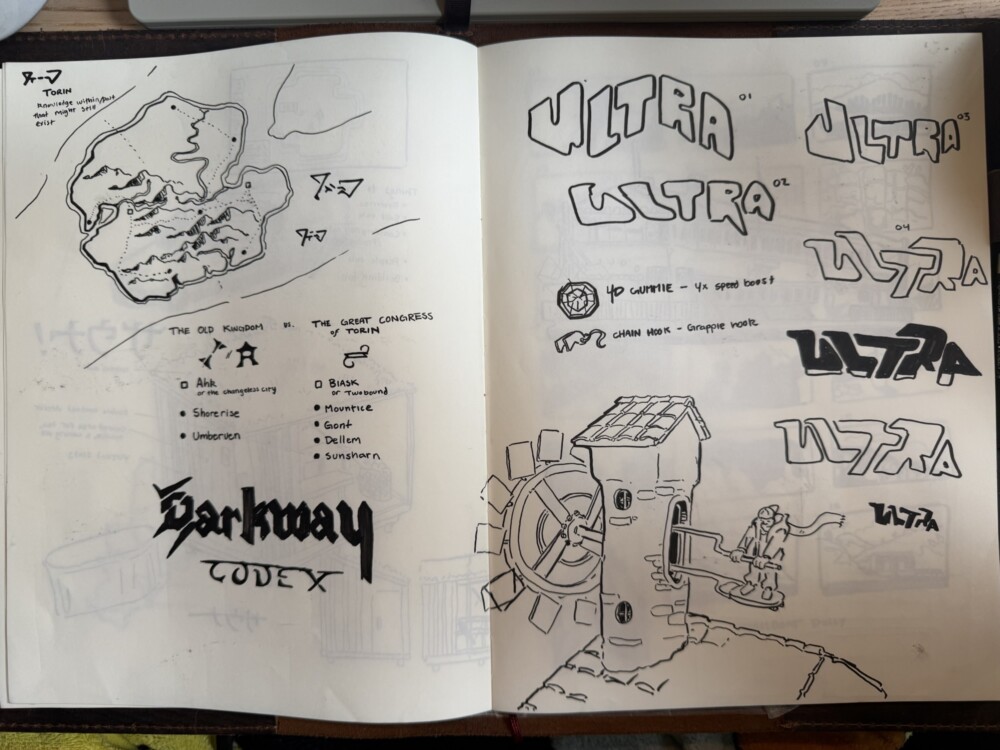
I work as a world builder. I was hired to one of my favorite jobs: Art Director at Skypunk, under the premise that I would worldbuild for the video game Braincell. I’ve been worldbuilding the world of Darkway since high school, a world that now has a game: Murder of King Mere.
I have worked very hard to make the world of Darkway a feasible one; not one that exists, but one that could exist. This might not seem the case, my currently one published work is represented by a cute anthropomorphic dogs, but there is a ton of science manipulation behind how someone ends up in the Darkway to the point that the Darkway fantasy world is borderline sci—fi.
But this Darkway worldbuilding hints at something Plato honed in on when he was creating his own systems of worldbuilding: Not all stories and systems are created equal, some are pure mythos (story) while others are laden with logos (evidence / reasoned account).
The key difference between the ‘civilization starts at Uruk’ and ‘Civilization began before Uruk’ is one has a significant advantage over the other; external evidence provides backing, enough for researchers to assert it as the true narrative. It is worldbuilding rooted in logos.
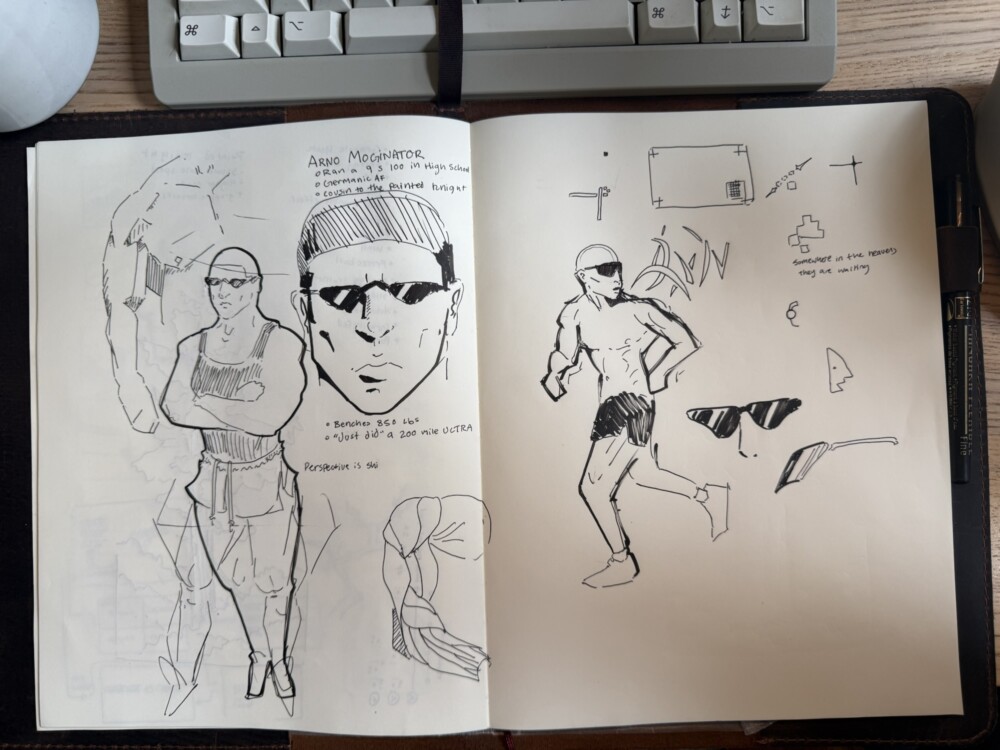
The two previous examples: maps and money, are perfect examples of logos and mythos.
Usable maps must be based on Logos, otherwise they are pure fantasy (in that case their use might be confined to storytelling scenarios like a video game or Dungeons and Dragons), whereas money is based entirely on the shared belief everyone has on the system, and economists’ balancing act to maintain viability of said system.
While science, and the way we go about it with our systems, is another form of worldbuilding (one that is almost entirely systems based), it has proven an incredible tool in piecing together the mysteries of our reality and other worldbuilding endeavors.
But even if the system of science was perfect, the inevitability of human thought seems to tends towards creativity; thus beliefs like the flat earth conspiracy theory.
Flat Earth has rallied quite a number of individuals to it’s worldbuilding in spite of science’s attempts otherwise. From my research, part of the reason why seems to be that it offers an entirely new worldbuilt mythos regarding ‘science’ for those disillusioned by modern day science.
Science builds complex systems of understanding excellently, but often those systems are often so complex they become not believable or easily understandable. While it’s outside the scope of this essay to discuss how conspiracy theories emerge, they seem to emerge when the mainstream narrative is:
- not in alignment with beliefs or values of an individual
- too complex to succinctly understand (Occam’s Razer effect.)
- not ‘cool’, or convincing enough.
This is where treating any craft or contribution to human knowledge as worldbuilding becomes a key decision. If we create additional information for the human library of knowledge without treating it with the care and forethought that comes with the art of worldbuilding, we might create a system rooted in logos but with little to no mythos, or logos too complex to understand. Or the flip side, we might create a mythos for mass belief that has no logos backing; or worse, bend logos to fit whatever mythos we decide is true.
Over the course of 240-300 generations, we as a species have crafted a grand mythos that has allowed us to build entire cities of calculation that fit in our pockets, cylinders of metal that rocket into the vault of stars, and layers of equations and letters that have cured the most horrible diseases that plagued humanity for hundreds of years. But these advancements were not made on myth alone – they were made on logos also.
The Space Race is an excellent example of this: every advancement was rooted in equations, engineering, programming, logos! (we were running these rockets off of a 70 lbs. computer with 64 kb of RAM. This essay is about 10 kb, for reference.) But without Kennedy’s “We CHOOSE to go to the moon. Not because they are easy, but because they are hard. Because that goal will serve to organize and measure the best of our energies and skills.” we maybe would never have made it.
Belief. Belief is not just facts: it is emotional investiture, something that is only achieved through the grand arc of a story. It would be much more difficult to convince a human to jump into a metal can that would take them to an independent solar body called the ‘moon’, thousands of miles from their home, without a mythos they felt made it worthwhile.
Logos provides results. Mythos convinces that those results are true.
Great worldbuilding is something that is not only fantastical but is rooted in the logos of previous worldbuilt systems. Facts packaged in story. (Or, if worldbuilding for fantasy: story and manufactured facts that are believable if for a split second, players/readers/watchers feel as though that fantastical world is the real. I expand upon this in depth in my published essay: Creating Project Contrast: a Video Game exploring Consciousness and Qualia)
Looking back at the full arc of human civilization, humans have been surviving and crafting mythos and logos to pass forward like a baton, slowly creating a world we might understand and influence. Whatever we today add to this baton (an essay, a video game, a story, an equation) we are participating in the oldest human project: worldbuilding. Worldbuilding is not a metaphor for how humans organize reality, it is a process that we engage in to organize and discern our reality. Sure, it might be used for fiction (in fact it should, it’s a great use of worldbuilding), and the mythos to logos ratio grandly determines whether or not the worldbuilding will land and spread. Information must make sense, and it must resonate. If we succeed at both, we might better understand this reality we live in.