It’s a sunny winter morning. The air freezes the tips of ears and smells like that strange crispness you only find when the temperature drops near freezing. It’s the perfect day to be creative at a coffee shop.
The cold chill means the fires are lit at the local cafe Sabine – they have these huge gas powered fire stoves that pump out heat like some Dwarven Forge in Lord of the Rings – but it’s just a coffee shop, not a forge. When I was walking past in late November, I saw them lit for the first time and went inside.
Ordering my trademark drip coffee (which I was very pleased to learn has infinite refills – infinite so long as you have a high caffeine tolerance), and sat by the fire.
When I go to a coffee shop, I often go to work. Either on personal projects, or ‘work’; game development, concept art, computer stuff. This means I use my laptop, a computer that for its overpowered specs, running a 4060 and 64 gb of ram, dies after about 30 minutes of running Unreal Engine.
When I am at a coffee shop I tend to be attached to an outlet.
For all its wonderful vibes, and immense power output from their gas fires, there are no outlets by the fire. That first time I did not know this, and when my low battery chimed on that round table with the fire in the center, I scanned the room and found the closest outlet was perhaps the furthest you could get from the fires.
I put the laptop, Artbook I call it, back in my bag,
And out came the sketchbook.
I rely on physical media. While I am typing this on my computer, most of my ideas come from the paper and ink that I always seem to have with me. Why then, when there is a blank page, do ideas seem to come much more slowly?
It baffles me – there are quite literally near infinite possibilities with a blank page l(I did the math on this previously with a 1000×1000 pixel canvas, and the possibilities for every pixel combination were a REALLY big number. Ink doesn’t have pixels so it approaches infinity.)
I call this the Blank Page Paradox.
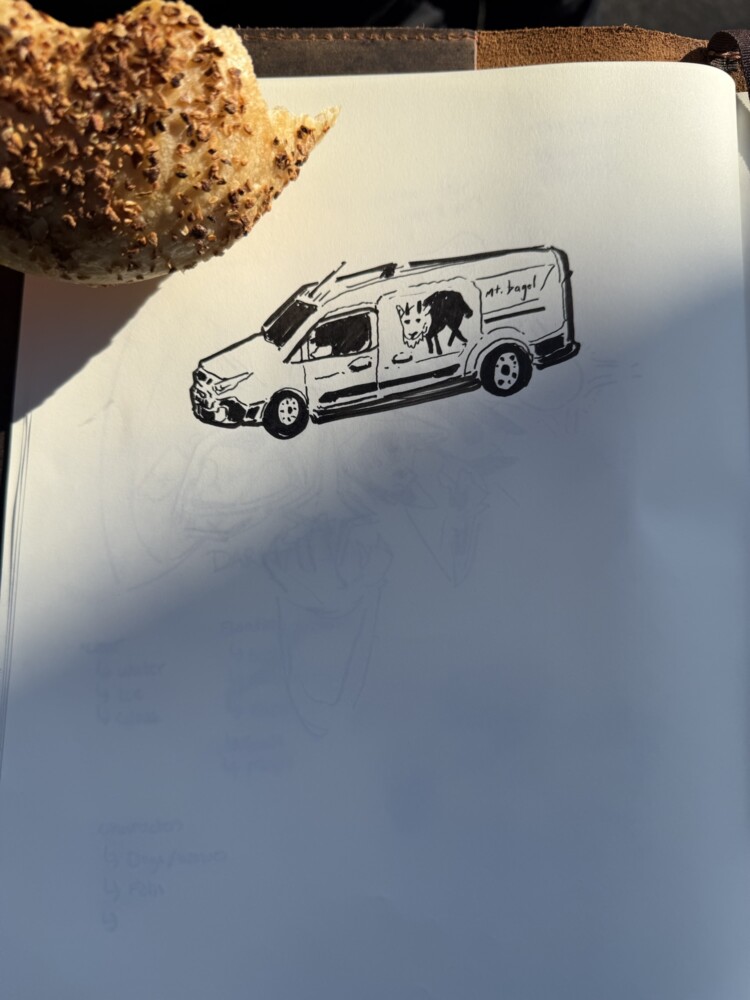
I opened my sketchbook in Sabine, the fire light warming the pages, the dry air making them smooth to the touch. It’s a new sketchbook too so that pages still lie flat unburdened by ideas yet to be writ. The blank page…
There is some sort of stare that occurs when encountering a blank page, when no idea has been planned. It’s a stare that is accompanied by the mental commentary ‘What should I do?’ -or draw. A mental note of desperation.
Why should we as creators have this? When encountering infinite possibility, even the greatest artists if they don’t just start drawing, encounter this moment of indecision, or worse: lack of possibility, lack of ideas.
Something many artists are familiar with is Inktober – if you’re a game developer you might be familiar with game jams. Or if you are reading this and know neither, surely you must know the simple ‘time limit’?
These all place seemingly arbitrary yet significant restrictions on this infinite possibility: Inktober provides prompts for each day, Game Jams provide themes and a 48 hour time limit, and time limits limit time. Each prioritize action over intention through a set of narrowing of the infinite possibility. The Blank Page paradox is this; it is simply a Paradox of Choice, as popularized by Barry Schwartz in his book of the same name.
Arbitrary limits works to propel ideas forward because they narrow the possibilities into a set of possibilities that either must be decided upon, or by simply making it easier to decide by narrowing the possibility.
When there is infinite choice, there is no starting point other than slipping into somewhere in the infinity; in this ‘slipping’, there then are arbitrary restrictions placed: ‘What if I draw something medieval?’, we are now in the range of medieval things on the scale of infinity, and therefore confined to a smaller subset of choices.
The Blank Page is a paradox because it provides infinite choice and therefore should render amazing ideas. But without a starting point, the infinity becomes zero (nod to the book Zero: The Biography of a Dangerous Idea by Charles Siefe.) In choosing we collapse the infinite possibilities into a defined possibility, until we do this we have zero options because we cannot compare and iterate ideas along an infinite spectrum with our finite minds.
The man who officiated my wedding and one of my closest friends, Simon, frequently tells me to make pros-cons lists when I can’t decide. He is very wise, so I heed his advice. But a pro-con list takes time, often rendering a complete view of available choices. This pro-con list is what our brains intuitively do on a micro scale when deciding between two things – either from a logical basis or vibes basis depending on personality.
This is the main premise of the Paradox of Choice – in having a larger subset to pick from, we simply cannot choose. It becomes increasingly difficult to weigh the value of one idea over another when there are additional ideas. The consideration of one idea takes mental effort, it takes even more mental effort to compare an idea against another idea; and this mental effort increases with additional ideas to compare. The pro-con list quickly becomes a Homeric Epic!
So the key, then, is to refine your initial ‘picker’. This is the main skill in concept art. To pick an idea out of the infinite that is already good: either pulled somewhere from randomness or from the creative unconscious mind, and do that from three maybe four ideas. Concept artists are good at this because the market is competitive and they have to be good or they won’t have work, essentially the skill to be creative enough to pick something good out of the infinity. Another reason concepts artists are good at this (and any engineer adjacent career) is because their arbitrary rule set is bent towards problem solving. If there is a problem that needs solving, that significantly limits the viable number of options.
So the strategy goes a little like this, addressing the Blank Page Paradox
- Have an arbitrary rule set for the infinite options. Either time limit, theme, or something that needs to solve for something. (For concept art it could be a character design of a knight, or for engineering it could be how to create armor for finger joints.)
- From that rule set, decide the best way to solve for said rule set. Pick from a few options.
- Bam, now you have something to draw.
Easier said than done of course, but sometimes blank pages fill just by exploring the 2-3 different options that you initially decide.
I sat by the fire, a Vulcan fixture, my laptop nearing death. I had near infinite possibilities of what I could do next: I could go to the outlet, I could take out my phone and write this essay, I could go to another coffee shop. But I had a problem to solve: Enjoy the fire. I could just stare at it? I could also use my phone by the fire and tap on the tiny glowing on screen keyboard? But what better way to enjoy the fire than to use something that is warmed by fire? Paper.
So the infinite collapsed under my unconscious realization that the paper would be warm in my sketchbook, and so began the Sketchbook Paradox.
If Zero and Infinite are twins,
Both extending beyond the known into the cold abstraction of unknowing
Perhaps the warmth is in those ones, twos, and perhaps threes.
PS. I know this does not dive into determinism at all in choice making: our minds seem to disregard determinism when trying to decide between options. Knowledge and/or belief in determinism does no more than add an apathetic indifference to the choice chosen, so I chose not to include determinism as a subject of the ‘Blank Page’. Instead, focusing on practical applications rather than metaphysical musings.